
You own Florida land you do not use — and the annual property tax bill keeps arriving.
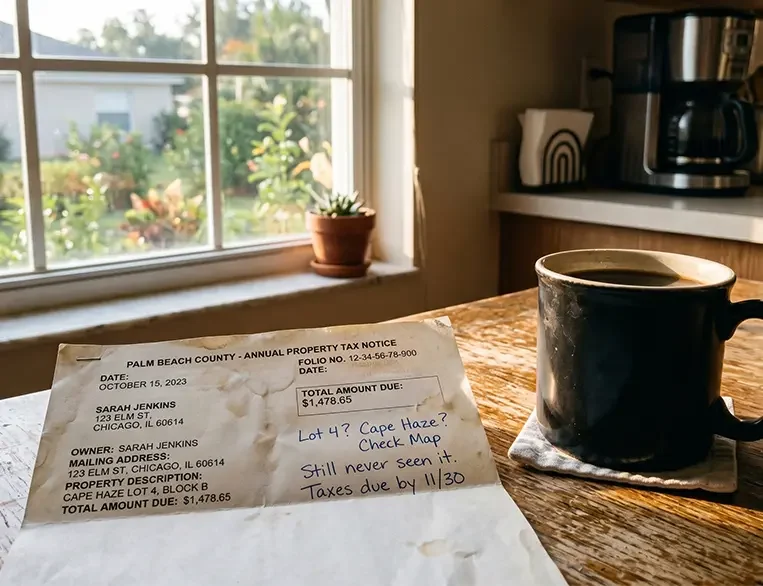
Maybe it is a quarter-acre lot in Lehigh Acres your mother bought in 1962 and never built on. Maybe it is two lots in Golden Gate Estates an uncle left you. Maybe it is five acres in Charlotte County you bought years ago for a plan that changed. What it is not, anymore, is land anyone is using — and every year a Florida county sends a tax bill that has to be paid out of pocket on a parcel that produces no income.
This guide explains what the Florida vacant-land market actually looks like in 2026, why so much of it traces back to the 1960s platted-lot boom, what the property tax picture looks like on vacant Florida land, and what working with Sell Land — Bob and Carly Scott, in business twenty years, buying vacant land in all fifty states — looks like from the seller’s side of the table.
Why So Much Florida Land Is Empty: The 1960s Platted-Lot Boom
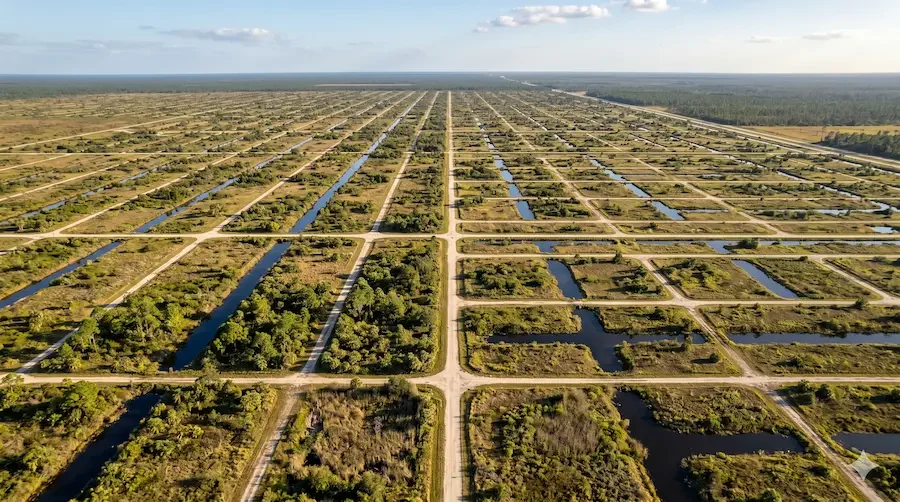
More Florida land was subdivided into lots in the 1960s than in the rest of the country combined. Companies like Gulf American — founded by the Rosen brothers — platted Cape Coral in Lee County and the enormous Golden Gate Estates in Collier County, where roughly 111,000 acres were cut into 1.25-acre lots and about 18,000 were sold, mostly sight unseen, by 1967. Lehigh Acres was platted the same way. Lots were sold on installment plans — famously a few dollars down and a few dollars a month — to out-of-state buyers who often never visited. Decades later, much of Southern Golden Gate Estates was bought back by the state for the Picayune Strand Everglades restoration because the land was never truly buildable. The result today: hundreds of thousands of small Florida lots held by the original buyers’ heirs, many in wetland or without infrastructure, all still generating an annual tax bill.
The Florida Property Tax Picture on Vacant Land
Florida levies no state income tax, and funds local government largely through property tax. Vacant land gets no homestead exemption and no Save Our Homes assessment cap — those apply only to a homestead — so a vacant lot is assessed at just value and the bill can climb year over year. Agricultural land may qualify for a reduced assessment under the agricultural classification (the “greenbelt” law, Florida Statutes s. 193.461), but a small platted lot rarely qualifies. For most absentee owners, the lot is a pure annual cost with no offsetting use or income.
Real Experiences From Land Sellers Across United States

Jay Shultz

“Selling land is a different beast than selling a house. It was so refreshing to find out that Bob at Sell Land was super knowledgeable and had me covered in every way. He understands the nuances of buying land and also my unique needs. He is great to work with and if you have land you want to sell, Sell Land is the company and Bob is the man“

David M.
“Bob is a young man with a vision and aptitude for recognizing opportunities. He implements a plan and creates a winning situation for his clients. Bob continues to touch people’s lives based on their objectives with real estate. If you are entering the market as a seller, I could not recommend anyone more qualified or dedicated than Bob Scott.”
The Real Cost of the Traditional Listing Route on Florida Land
Many owners assume the alternative to a cash sale is a standard listing. On vacant land that route is slower and costlier than expected. Vacant-land listings commonly carry commissions of 6 to 10 percent — higher than the residential norm — because the work is specialized: comparables are scarce, the buyer pool is smaller, and small platted lots in particular can sit for a year or more. Add seller-side closing costs, a survey if the buyer’s lender requires one, marketing costs, and the annual tax meter that keeps running while the listing sits, and the traditional route often consumes far more than owners expect before the parcel sells.
What a Cash Sale With Sell Land Actually Looks Like
Three steps. Same-day cash deposit on offer acceptance. Direct buyer — Sell Land is not a wholesaler, and we close with our own funds. Twenty years of land-specific experience across all fifty states.
- You send us your property details. Use the form below or call Bob or Carly directly at (314) 639-9800. We ask the basics — county, approximate size, parcel number if you have it, and how you came to own it. Five minutes. No photos or surveys needed.
- We send a written cash offer within 24 hours. A real number, in writing, with no financing or buyer-inspection contingency. The moment you accept, we deliver a same-day cash deposit through the title company — your evidence that we are the buyer the contract says we are.
3. We close on your timeline and pay all closing costs. Most closings run two to four weeks. You pay no commission and no seller-side closing costs. Florida permits remote online notarization (s. 117.201), so most out-of-state owners never travel to Florida.
Ready to See a Real Number on Your Florida Land?
One written offer. Same-day cash deposit when you accept. Twenty years of land-specific experience. Direct buyer — closing with our own funds, not searching for someone to assign the contract to. Whether it is one platted lot or fifty acres, the offer process is the same.
Contact Us Now And Get Your Free, Fair All-Cash Offer Today.